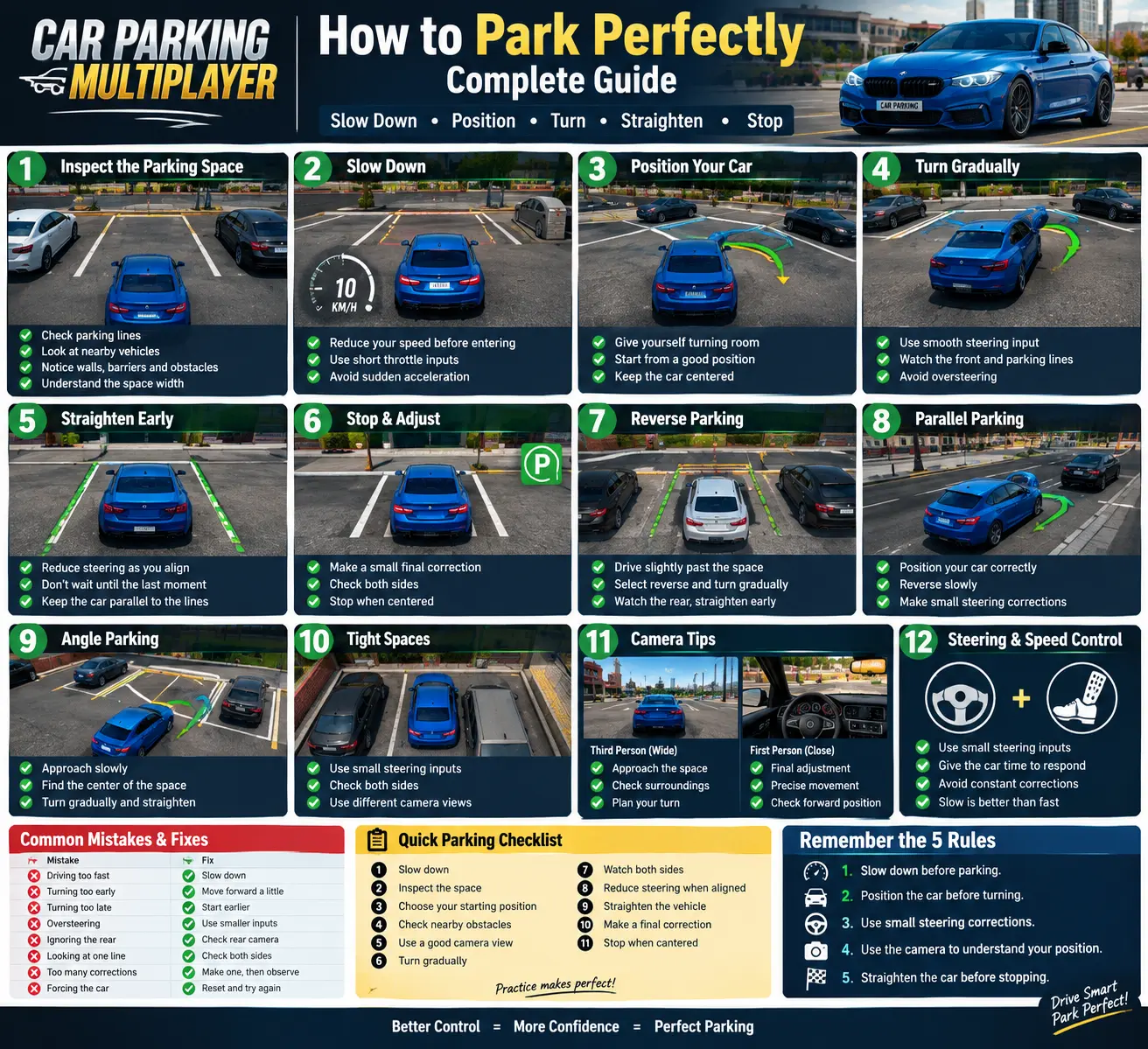
How to Park Perfectly in Car Parking Multiplayer: Parking Tips & Complete Guide
Parking in Car Parking Multiplayer may look simple at first, but fitting your car perfectly into a parking space requires control, timing, and practice. Reverse parking, parallel parking, tight spaces, difficult angles, and narrow gaps can become challenging when you are not comfortable with steering, speed, and camera control.
If you are looking for more information about the game, you can also explore our Car Parking Multiplayer guides and resources.
Quick answer: To park perfectly in Car Parking Multiplayer, slow down before entering the space, position your car correctly, turn gradually, use small steering corrections, and straighten the vehicle before stopping. The key is controlling your speed and making corrections early instead of trying to fix everything at the end.
The good news is that you do not need complicated tricks to become a better parker. The most important skills are low-speed control, correct positioning, smooth steering, camera awareness, and small corrections.
In this guide, you will learn how to park perfectly in Car Parking Multiplayer, including forward parking, reverse parking, parallel parking, angle parking, tight spaces, steering control, camera techniques, common mistakes, and a practical training routine.
What Does Perfect Parking Mean in Car Parking Multiplayer?
Perfect parking is not simply getting the car inside a parking space.
A properly parked vehicle should:
- Stay inside the marked parking area
- Be reasonably centered
- Have enough clearance from nearby vehicles and obstacles
- Be aligned with the parking lines
- Avoid unnecessary collisions
- Require very few final corrections
The exact technique can change depending on your vehicle and the size of the parking space.
Instead of memorizing one exact steering pattern, learn how your car responds to steering and adjust your timing accordingly.
One useful habit is to focus on where the mistake begins, rather than only looking at the final position.
For example, if the car finishes too far to the left, ask yourself when it first started moving away from the center. Fixing that moment will usually improve your next attempt.
Start With the Right Controls
Before practicing difficult parking maneuvers, make sure you are comfortable with your controls.
The best setup is the one that allows you to make small and predictable movements.
Practice Steering
Start in an open area and drive slowly.
Make a small left steering input and return the steering to the center. Repeat the same movement on the right.
This helps you understand how quickly your vehicle responds.
Do not immediately practice in the tightest parking space. First learn how much the car moves with a small steering input.
Learn Throttle and Brake Control
Parking should normally be performed at low speed.
Instead of holding the accelerator continuously:
- Use short throttle inputs
- Release the accelerator before tight turns
- Brake gently when necessary
- Avoid sudden acceleration
- Keep the vehicle slow enough to make corrections
If you keep crossing parking lines, reducing your speed is usually a better first adjustment than changing your entire steering technique.
The Basic Parking Formula
Most parking maneuvers can be simplified into five steps:
Approach → Position → Turn → Straighten → Stop
1. Approach
Slow down before reaching the parking space.
2. Position
Put your vehicle in a useful starting position before turning.
3. Turn
Turn gradually while watching the direction of the car.
4. Straighten
Once the vehicle is aligned with the parking space, straighten the steering.
5. Stop
Make a small final adjustment and stop when the vehicle is properly positioned.
This simple sequence works as a framework for forward, reverse, angle, and parallel parking.
How to Park Perfectly Step by Step
For normal forward parking, follow these steps.
1. Inspect the Parking Space
Before entering the space, look at:
- Parking lines
- Nearby vehicles
- Walls
- Barriers
- The width of the space
- The direction of the parking area
Knowing where you want the car to finish is easier than trying to fix the position after entering.
2. Slow Down
Reduce your speed before starting the turn.
A common beginner mistake is entering a parking space too quickly and then trying to make large steering corrections.
3. Give Yourself Enough Turning Room
Do not position your car too close to the parking space if you need room to turn.
Give the front of the vehicle enough space to rotate into the area.
4. Turn Smoothly
Begin steering gradually.
Watch the front of the vehicle and the parking lines instead of constantly changing direction.
5. Start Straightening Early
As the car becomes aligned with the parking space, reduce your steering input.
Do not wait until the car is already too far to one side.
6. Make the Final Adjustment
Move forward or backward slowly if needed.
Stop once the vehicle is centered and safely inside the parking area.
Practical tip: If your car is already aligned, do not keep steering simply because you think another correction is needed. Sometimes the best correction is to straighten the wheels and let the vehicle settle into the space.
How to Reverse Park in Car Parking Multiplayer
Reverse parking is one of the most useful skills to learn because it teaches you how the rear of the vehicle responds to steering.
Step-by-Step Reverse Parking
- Drive slightly past the parking space.
- Slow down almost to a stop.
- Position the vehicle so there is enough room to reverse.
- Select reverse.
- Start turning toward the parking space.
- Reverse slowly.
- Watch the rear and front corners of the vehicle.
- Reduce the steering input as the car enters the space.
- Straighten the wheels.
- Make a small final correction if necessary.
The most important rule is simple:
Do not reverse too quickly.
A slow reverse gives you more time to understand where the vehicle is going.
Reverse Parking Example
Suppose the parking space is on your right.
Drive slightly beyond the space and slow down. Begin reversing while turning toward the space. As the rear of the car enters, reduce your steering input.
When the car becomes almost parallel with the parking lines, straighten the wheels.
If the vehicle enters at the wrong angle, do not force it forward. Move out slightly, reset your position, and try again.
Practical tip: When learning reverse parking, repeat the same parking space several times instead of changing locations after every attempt. This makes it much easier to understand how your steering input changes the vehicle’s path.
How to Parallel Park
Parallel parking can be more difficult because the available space is usually narrower.
Step 1: Position Your Car
Move alongside the parking area and leave enough room to begin reversing.
Step 2: Start Reversing Slowly
Begin reversing while turning toward the parking space.
Step 3: Watch the Rear Corner
Pay attention to the rear of the vehicle and nearby obstacles.
Step 4: Begin Straightening
As the car enters the space at an angle, reduce the steering input.
Step 5: Correct the Front
Use a small steering correction to bring the front of the car into the space.
Step 6: Center the Vehicle
Move forward or backward slowly until the vehicle is properly positioned.
You do not need to complete parallel parking in one movement. A controlled correction is much better than hitting another vehicle.
How to Park at an Angle
Angle parking is usually easier because the parking space provides more room for the vehicle to enter.
Follow These Steps
- Approach the space slowly.
- Identify the center of the parking area.
- Give the vehicle enough room to turn.
- Begin turning toward the space.
- Reduce steering as the vehicle reaches the correct angle.
- Straighten the car.
- Stop when it is safely inside the lines.
Common Angle-Parking Mistake
One of the most common mistakes is turning too early.
If your car enters the space at the wrong angle, do not keep forcing it forward. Reverse slightly, adjust your position, and try again.
How to Park in Tight Spaces
Tight parking requires patience and precise control.
The first thing you should do is slow down.
Use Small Steering Inputs
Avoid constantly using maximum steering.
Instead:
- Make a small steering adjustment
- Let the car respond
- Check the position
- Make another adjustment if needed
This gives you much more control.
Watch Both Sides
Do not focus on only one parking line.
Your vehicle may look perfectly positioned from one side while being dangerously close to an obstacle on the other side.
Check both sides before making the final stop.
Use the Camera to Your Advantage
Change your camera view when you need a better understanding of your car’s position.
A wider view can help you see surrounding objects, while a closer view can make final positioning easier.
How to Use the Camera for Better Parking
Camera awareness is extremely useful when parking.
Third-Person Camera
A wider third-person view is useful when:
- Approaching a parking space
- Checking surrounding vehicles
- Planning a turn
- Looking at the overall position of the car
First-Person Camera
First-person view can be useful when:
- Making a final adjustment
- Practicing precise movement
- Checking the vehicle’s forward position
Change Camera Views When Necessary
You do not need to use one camera for the entire parking maneuver.
A useful approach is:
Wide view → parking maneuver → closer view for final alignment
The best camera is the one that gives you the clearest view of the vehicle and its surroundings.
Steering Techniques for Perfect Parking
Steering control is one of the most important parts of parking.
Avoid Oversteering
Large steering movements can quickly change the direction of the car.
Use:
- Larger steering inputs for the initial turn
- Smaller inputs while aligning
- Minimal steering for the final correction
Learn Counter-Steering
If the car starts entering the parking space at the wrong angle, use a small steering correction in the opposite direction.
Do not immediately use maximum steering.
Make a small correction, observe the vehicle, and adjust again.
Give the Car Time to Respond
A common beginner mistake is changing steering direction too quickly.
Make an input and give the car enough time to respond before making another major correction.
How to Control Speed While Parking
Speed control can make parking dramatically easier.
When parking:
Slow is better than fast.
Use gentle throttle and brake inputs.
If you are approaching a wall, vehicle, or parking line too quickly:
- Release the accelerator.
- Reduce your speed.
- Check your position.
- Make a small steering correction.
- Continue only when you have enough space.
Do not try to fix a speed problem with steering.
Slow the vehicle first.
When Should You Straighten the Steering?
Knowing when to straighten the steering is one of the most important parking skills.
While turning into a parking space, your car rotates toward the target.
Once the vehicle is almost parallel with the parking lines, stop increasing the steering angle.
Then gradually straighten the wheels.
A simple rule to remember is:
Turn to enter → reduce steering to align → straighten to finish.
Why Your Parking Goes Wrong: Problem → Cause → Fix
Sometimes knowing the mistake is not enough. You also need to understand why it happened.
| Problem | Possible Cause | What to Do |
|---|---|---|
| Car goes too far left | Turn started too early or steering was held too long | Reduce steering earlier |
| Car goes too far right | Starting position or turn timing was incorrect | Adjust your approach position |
| Front enters but rear hits | Poor rear clearance awareness | Use a wider camera view and reverse slowly |
| Car enters at a bad angle | Turn was too early or too late | Reset and change the turning point |
| Car crosses parking lines | Speed was too high or correction came too late | Slow down and correct earlier |
| Too many left-right corrections | Steering is being changed too frequently | Make one correction and wait for the response |
| Vehicle is almost aligned but still moves sideways | Steering was not straightened soon enough | Center the steering before the final movement |
This approach is more useful than simply repeating the same parking attempt without identifying the cause.
Common Parking Mistakes and How to Fix Them
Driving Too Fast
Problem: You enter the parking area before you have time to correct the car.
Fix: Reduce speed before turning.
Turning Too Early
Problem: The car enters the space at the wrong angle.
Fix: Move slightly farther forward before beginning the turn.
Turning Too Late
Problem: The car misses the center of the parking space.
Fix: Start the turn slightly earlier while maintaining low speed.
Oversteering
Problem: The vehicle swings too far.
Fix: Use smaller steering inputs.
Ignoring the Rear of the Vehicle
Problem: The front looks clear but the rear hits an obstacle.
Fix: Check the rear camera and surrounding area when reversing.
Looking at Only One Parking Line
Problem: One side looks perfect while the other side is too close.
Fix: Check both sides before stopping.
Making Too Many Corrections
Problem: Constant left-right steering makes the vehicle difficult to control.
Fix: Make one correction, observe the result, then make the next.
Refusing to Reset
Problem: You keep forcing the car into a bad position.
Fix: Reverse out, reset the angle, and try again.
Practical Parking Tips From Repeated Practice
One of the easiest ways to improve is to stop treating every parking attempt as a separate challenge.
Instead, repeat the same maneuver several times.
For example, choose one parking space and try to enter it five times.
After each attempt, ask:
- Did I start the turn too early?
- Was my speed too high?
- Did I straighten the steering too late?
- Did I leave enough turning room?
- Did I check both sides?
- Did I make too many corrections?
This creates a simple feedback loop:
Attempt → Identify mistake → Change one thing → Try again
Changing only one variable at a time makes it much easier to understand what actually improved your parking.
How to Complete Parking Challenges More Easily
Car Parking Multiplayer includes dedicated parking and driving challenges, making them useful for practicing vehicle control.
Do not always treat them like races.
Use them to improve specific skills.
Practice Forward Parking
Focus on:
- Speed control
- Entry angle
- Steering
- Alignment
Practice Reverse Parking
Focus on:
- Rear movement
- Camera awareness
- Steering corrections
- Straightening the vehicle
Practice Tight Parking
Focus on:
- Low speed
- Small steering inputs
- Distance judgment
- Camera switching
Practice Difficult Parking
Once you are comfortable with individual techniques, combine them in more difficult parking situations.
The goal should be consistent control, not simply completing the challenge as quickly as possible.
A Simple 15-Minute Parking Practice Routine
You can improve your parking skills with a short, focused practice session.
Minutes 1–3: Straight-Line Control
Drive slowly and practice keeping the car centered.
Minutes 4–6: Forward Parking
Use the same parking space repeatedly.
Focus on entering at a consistent angle.
Minutes 7–9: Reverse Parking
Practice reversing into the same space.
Focus on the rear of the vehicle and steering response.
Minutes 10–12: Parallel Parking
Practice entering and straightening the car.
Minutes 13–15: Tight Parking
Choose a smaller space and practice low-speed corrections.
The goal is not to finish as quickly as possible.
The goal is to understand why each parking attempt succeeds or fails.
Advanced Parking Tips
Once basic parking becomes comfortable, focus on consistency.
Learn Your Car’s Turning Behavior
Different vehicles can feel different.
Learn how much steering is needed for your preferred car instead of assuming that one technique will work exactly the same for every vehicle.
Use Visual Reference Points
Use parts of the vehicle and surrounding environment as reference points.
For example:
- Front corner relative to the parking line
- Rear corner relative to the space
- Side of the car relative to another vehicle
- Position of the hood relative to the parking area
With practice, these reference points become easier to recognize.
Make Fewer Corrections
Fewer corrections can make your parking smoother, but do not force yourself to complete every maneuver in one movement.
Accuracy should come before speed.
Practice With Your Main Car
If you normally drive one vehicle, practice with that vehicle.
Once you understand its turning behavior, parking becomes more predictable.
How to Park Without Hitting Other Cars
Use this simple process:
- Slow down before entering the space.
- Check both sides.
- Look at nearby vehicles and obstacles.
- Plan your turning path.
- Turn gradually.
- Watch the outside corner.
- Check the rear when reversing.
- Stop if the clearance becomes uncertain.
- Correct the position instead of forcing the maneuver.
Leaving a little extra space is often better than trying to squeeze through a difficult gap.
What If You Want an Older Version?
Some players prefer an earlier version because they are more comfortable with its gameplay, controls, or performance on an older device.
If you are looking for previous releases, check our Car Parking Multiplayer Old Versions guide for information about older releases.
Before installing an older version, make sure it is compatible with your device. Older builds may also lack newer features, fixes, or compatibility improvements.
What If You Want to Try the Beta Version?
If you want to test new features or changes before they are widely available, you can learn more through our Car Parking Multiplayer Beta Version guide.
Beta versions can change over time and may contain bugs or unfinished features, so they are better suited to players who are comfortable testing new builds.
Quick Parking Checklist
Before parking, remember:
- Slow down
- Inspect the parking space
- Choose your starting position
- Check nearby obstacles
- Choose a useful camera view
- Begin the turn gradually
- Watch both sides
- Reduce steering when aligned
- Straighten the vehicle
- Make a small final correction
- Stop when centered
Frequently Asked Questions
How do I park perfectly in Car Parking Multiplayer?
Approach the parking space slowly, position the car before turning, use controlled steering, watch both sides of the vehicle, and straighten the car before stopping.
How do I reverse park in Car Parking Multiplayer?
Move slightly past the parking space, slow down, select reverse, turn gradually toward the space, and watch the rear of the vehicle. As the car becomes aligned with the parking lines, straighten the steering and make a small final correction.
Why do I keep crossing the parking lines?
You may be entering too quickly, turning too early, or continuing to steer after the vehicle is already aligned. Slow down and focus on the moment when the car first becomes misaligned.
What camera should I use for parking?
Use the camera that gives you the clearest view of your vehicle and the parking area. A wider view can help with approach and surroundings, while a closer view can help with final alignment.
How can I get better at tight parking?
Drive slowly, use small steering inputs, check both sides of the vehicle, and practice reversing. If your angle becomes difficult to recover, reset the vehicle instead of forcing the maneuver.
Is reverse parking harder than forward parking?
Reverse parking can feel harder for beginners because the rear of the vehicle responds differently to steering. With regular practice, however, it becomes much easier.
How do I stop oversteering while parking?
Use smaller steering inputs and give the vehicle time to respond. Avoid repeatedly moving the steering from one extreme to the other.
Should I use the same parking technique for every car?
The basic principles remain the same, but different vehicles can require different steering timing and spacing. Practice with the car you use most often.
How long does it take to become good at parking?
It depends on how often you practice. Short, focused sessions can be effective when you practice one maneuver at a time and identify the exact reason for each mistake.
Final Thoughts
Perfect parking in Car Parking Multiplayer is mainly about control, patience, and understanding how your car responds.
You do not need complicated tricks or a perfect first attempt.
Remember these five rules:
- Slow down before parking.
- Position the car before turning.
- Use small steering corrections.
- Use the camera to understand your position.
- Straighten the car before stopping.
Start with simple forward parking and then move to reverse parking, parallel parking, angle parking, and tight spaces.
Most importantly, learn from each attempt. If the car ends up too far left, too far right, or at the wrong angle, find the point where the mistake started and change that part of the maneuver.
With consistent practice, judging your car’s size, turning behavior, distance, and position becomes much easier. Eventually, even difficult parking situations will feel predictable rather than frustrating.